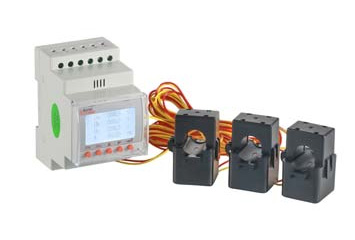
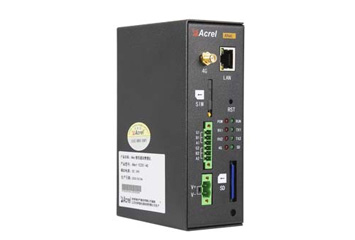
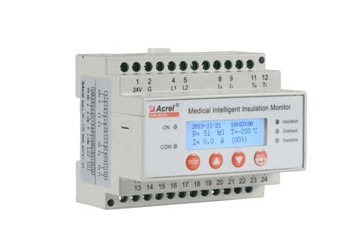
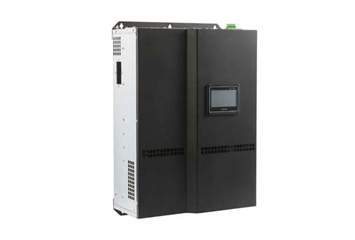
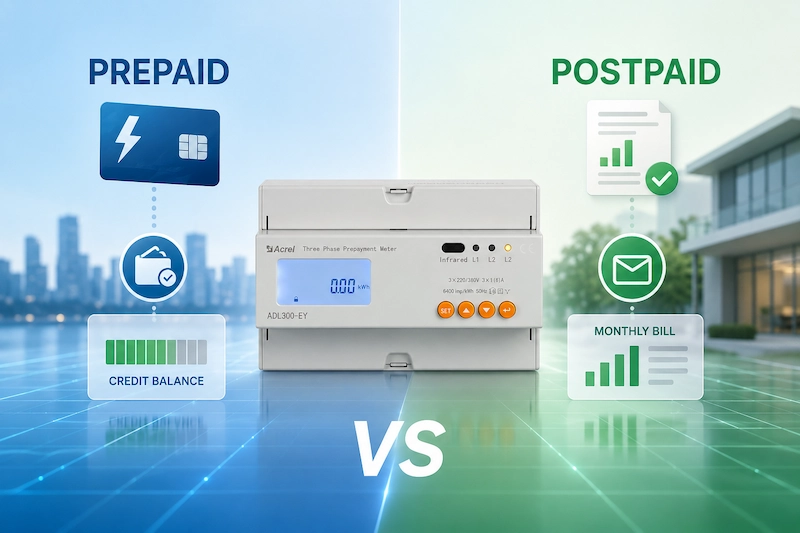
Prepaid energy metering with the adl300 is better suited for environments where cost control, risk reduction, and automated billing are priorities, while postpaid metering remains appropriate for stable users with established credit systems and centralized billing workflows. The choice depends on cash flow management, operational scale, and the level of control required over electricity consumption.
How ADL300 Supports Both Prepaid and Postpaid Metering
The adl300 three-phase energy meter is designed for flexible billing architectures. It supports:
Real-time energy measurement (kWh, voltage, current, power factor)
Remote communication via RS485/Modbus or IoT platforms
Integration with prepaid management systems
Load control and remote disconnection
This flexibility allows system integrators and facility managers to deploy either prepaid or postpaid billing models without changing hardware—only the software logic and system configuration differ.
What Is Prepaid Energy Metering and How Does It Work?
Prepaid metering requires users to purchase electricity credits in advance. The adl300 tracks consumption and deducts energy usage from the prepaid balance.
Operational Workflow
User purchases energy credits (via card, app, or platform)
Credits are uploaded to the system
The adl300 continuously deducts consumption
When balance reaches zero, supply can be limited or disconnected
Key Characteristics
No outstanding payments
Automated billing process
Real-time consumption visibility
Built-in load control capability
What Is Postpaid Energy Metering and How Does It Work?
Postpaid metering follows the traditional billing model where energy usage is recorded first and billed later.
Operational Workflow
The adl300 records energy consumption
Data is transmitted to a central system
Monthly or periodic bills are generated
Users pay after consumption
Key Characteristics
Credit-based billing system
Requires meter reading or automated data collection
Suitable for stable tenants or industrial users
Dependent on billing accuracy and payment cycles
Prepaid vs Postpaid: What Are the Key Differences?
| Aspect | Prepaid Metering (ADL300) | Postpaid Metering (ADL300) |
Payment Model | Pay before use | Pay after use |
Cash Flow | Positive (advance payment) | Delayed |
Risk of Non-Payment | Eliminated | Present |
Billing Process | Automated | Requires billing system |
User Control | High (budget-based usage) | Moderate |
Disconnection Control | Automatic | Manual or delayed |
For property managers and energy operators, prepaid systems using the adl300 significantly reduce financial risk and administrative workload.
Which Applications Are Best for Prepaid Metering with ADL300?
Prepaid systems are widely adopted in:
Commercial rental properties
Shopping malls and retail units
Dormitories and student housing
Industrial parks with multiple tenants
EV charging stations
In these scenarios, the adl300 enables transparent energy allocation and eliminates disputes over shared electricity costs.
When Is Postpaid Metering Still the Better Option?
Postpaid metering remains relevant in:
Large industrial facilities with stable operations
Corporate buildings with centralized billing
Utility-managed energy distribution systems
Long-term tenants with established credit agreements
Here, the adl300 functions as a high-accuracy data acquisition device integrated into enterprise billing systems.
How Does ADL300 Enable Prepaid Energy Management Systems?
The adl300 integrates seamlessly with prepaid platforms through:
RS485 Modbus communication
IoT gateways and cloud-based systems
Third-party billing software
Core Functional Capabilities
Real-time balance monitoring
Remote recharge and credit updates
Automatic load disconnection when credit is exhausted
Alarm notifications for low balance
These features allow operators to build scalable prepaid energy ecosystems with minimal manual intervention.
Does Prepaid Metering Improve Energy Efficiency?
Yes, prepaid systems typically lead to more conscious energy usage.
Users become more aware of consumption patterns because:
Energy is directly linked to cost in real time
Budget constraints encourage efficiency
Immediate feedback reduces waste
Deploying the adl300 in prepaid mode often results in measurable reductions in overall energy consumption.
How Accurate Is Billing with ADL300 in Both Models?
Accuracy is consistent regardless of billing model.
The adl300 provides:
This ensures that both prepaid and postpaid billing are based on reliable, verifiable data.
Can ADL300 Switch Between Prepaid and Postpaid Modes?
Yes, the transition is typically managed at the system level rather than requiring hardware replacement.
By updating:
the same adl300 device can support different billing strategies as business needs evolve.
What Are the Cost Implications of Prepaid vs Postpaid Systems?
Prepaid System Costs
Higher initial setup (software + integration)
Lower long-term operational costs
Reduced manpower for billing and collection
Postpaid System Costs
Over time, prepaid systems powered by the adl300 typically offer better return on investment in multi-tenant environments.
How Secure Are Prepaid Energy Metering Systems?
Security depends on system architecture.
With the adl300, security can include:
Encrypted communication protocols
User authentication for recharge systems
Access control for administrators
Audit logs for all transactions
This ensures that prepaid balances and energy data are protected against tampering.
Conclusion
Both prepaid and postpaid energy metering models have distinct advantages, and the adl300 provides the flexibility to support both within a single platform. Prepaid systems excel in cost control, automation, and risk reduction, while postpaid models remain suitable for stable, credit-based environments. Selecting the right approach depends on operational priorities, user behavior, and long-term energy management goals.
Frequently Asked Questions
What is the main difference between prepaid and postpaid energy meters?
Prepaid meters require payment before electricity usage, while postpaid meters bill users after consumption.
Is ADL300 suitable for prepaid systems?
Yes, the adl300 is widely used in prepaid energy management systems due to its communication and control capabilities.
Can prepaid meters disconnect power automatically?
Yes, when the balance reaches zero, systems using the adl300 can trigger automatic disconnection.
Which is better for rental properties, prepaid or postpaid?
Prepaid metering is generally more suitable because it eliminates billing disputes and ensures payment in advance.
Can one system support both prepaid and postpaid users?
Yes, with proper configuration, the adl300 can be integrated into systems that support both billing models simultaneously.
 English