The global energy metering landscape is undergoing a structural shift. Driven by renewable energy deployment, industrial digitization, and regulatory mandates for energy transparency, three-phase DIN rail energy meters have moved from niche measurement tools to strategic infrastructure components. For solar developers, utility planners, and energy equipment distributors making procurement decisions in 2026, understanding where this market is headed is essential.
Global Market Overview: Scale and Trajectory
The numbers tell a decisive story. The global three-phase DIN rail energy meter market reached an estimated $114.82 billion in 2025 and is projected to grow to $140.4 billion by 2026, reflecting a compound annual growth rate (CAGR) of 22.3%. These figures, drawn from The Business Research Company's Global Market Report 2026, underscore a market that is not merely expanding — it is accelerating.
Key Growth Drivers
Several interconnected forces are propelling this growth:
Solar PV Expansion: The global push toward distributed generation has created massive demand for bidirectional metering at the point of common coupling. Every new solar installation — whether commercial rooftop or utility-scale — requires accurate energy measurement for both consumption and export.
Industrial IoT Integration: Manufacturing facilities, data centers, and logistics hubs are embedding energy meters into their broader IoT ecosystems, using metering data to optimize operations, meet ESG reporting requirements, and reduce energy waste.
Smart Grid Investments: Government-backed grid modernization programs across Europe, Asia-Pacific, and the Middle East are replacing legacy electromechanical meters with intelligent, communicable alternatives.
Energy Efficiency Mandates: Regulations such as the EU Energy Efficiency Directive and comparable frameworks in Asia and the Americas are compelling commercial and industrial facilities to monitor, report, and reduce energy consumption — a requirement that begins with accurate metering.
Regional Breakdown
| Region | Market Share (2025) | Growth Driver | Notable Trend |
|---|
| Asia-Pacific | ~38% | Manufacturing scale, solar rollout | Largest volume market; China and India lead installations |
| Europe | ~28% | Energy efficiency directives, grid modernization | MID compliance is mandatory; strong retrofit activity |
| Americas | ~22% | Utility smart grid programs, EV infrastructure | North America leads in advanced analytics adoption |
| Middle East & Africa | ~12% | New infrastructure, renewable energy targets | Fastest percentage growth from a smaller base |
Europe's emphasis on the Measuring Instruments Directive (MID) makes certification a prerequisite for market entry. Distributors in this region must ensure every meter carries the appropriate conformity markings.
Technology Evolution: From Mechanical to Intelligent
The three-phase energy meter has undergone three distinct generational shifts over the past four decades, each expanding the device's role from simple measurement to active energy management.
First Generation: Electromechanical Meters
Spinning-disc meters offered only cumulative kWh readings, required manual reading, and provided no visibility into power quality or directional energy flow.
Second Generation: Static (Electronic) Meters
Solid-state measurement brought digital displays, higher accuracy, and multi-parameter measurement — voltage, current, power factor, and demand — in a smaller, more reliable package.
Third Generation: Smart Connected Meters
The current generation combines high-accuracy measurement with embedded communication, bidirectional energy registration, and edge computing capabilities — transforming meters from passive sensors into active nodes in an energy management network.
The compact DIN rail form factor (typically 35mm rail mounting) has been instrumental in this evolution. It allows meters to be installed in standard distribution panels alongside circuit breakers and other switchgear, enabling retrofits without structural modifications to existing electrical infrastructure.
Key Technology Trends in 2026
Six technology trends are shaping the competitive landscape for three-phase DIN rail meters in 2026.
1. Bidirectional Metering Becomes Standard
The growth of distributed solar generation and battery storage systems has made bidirectional energy measurement a necessity rather than a premium feature. Meters must now accurately register both imported and exported energy, often across multiple tariff periods. This capability is critical for net metering programs, feed-in tariff schemes, and self-consumption optimization.
For solar developers, this means specifying meters that handle reverse energy flow without accuracy degradation and report import/export data separately.
2. Multi-Protocol Communication
While RS485 Modbus-RTU remains the dominant communication protocol in industrial and commercial installations — owing to its reliability, simplicity, and vast installed base of compatible equipment — the communication landscape is diversifying:
| Protocol | Strength | Primary Use Case |
|---|
| RS485 Modbus-RTU | Proven, low-cost, widely supported | Industrial panels, BMS integration |
| Ethernet (TCP/Modbus) | High bandwidth, IP-based | Data centers, large commercial buildings |
| LoRaWAN | Long range, low power | Distributed assets, rural solar farms |
| Cellular (4G/NB-IoT) | No infrastructure required | Remote monitoring, utility-scale deployments |
Interoperability with inverter systems is critical for solar applications. Meters with native Modbus-RTU integrate directly with virtually all major inverter brands, reducing installation complexity.
3. Higher Accuracy at Lower Cost
Accuracy classes once reserved for utility revenue billing are now accessible at commercial price points. Class 0.5S active energy measurement — which guarantees accuracy within ±0.5% across a wide operating range — is increasingly standard in DIN rail meters targeting commercial and industrial applications. This democratization of precision means that energy audits, sub-billing, and performance guarantee verification no longer require expensive panel-mount instruments.
4. Harmonic Analysis and Power Quality Monitoring
With variable-frequency drives, EV chargers, and inverter-based generation introducing harmonics into electrical networks, power quality monitoring is moving from luxury to requirement. Current-generation meters with optional harmonic analysis modules provide THD data, individual harmonic orders, and power quality event logging — enabling facility managers to address issues before they cause equipment damage.
5. Edge Computing and Predictive Analytics
Advanced meters in 2026 are incorporating edge processing capabilities — performing demand forecasting, anomaly detection, and load profiling at the point of measurement rather than forwarding raw data to a central server. This reduces bandwidth requirements and enables predictive maintenance strategies that identify developing faults before they cause outages.
6. Cybersecurity and Tamper Detection
As meters become network-connected devices, cybersecurity is non-negotiable. Leading meters incorporate encrypted communication, secure boot processes, and tamper detection mechanisms that log physical intrusion attempts — capabilities increasingly specified in utility and critical infrastructure procurement.
Application Growth Segments
The demand for three-phase DIN rail energy meters is not uniform across sectors. Five application segments stand out as growth leaders in 2026.
Solar PV Monitoring (Fastest Growing Segment)
Distributed solar generation is the single most powerful demand driver for three-phase DIN rail meters. Every grid-connected solar installation requires metering at the point of common coupling, and the global surge in commercial and industrial rooftop solar — particularly in Europe and Asia-Pacific — is generating unprecedented metering demand.
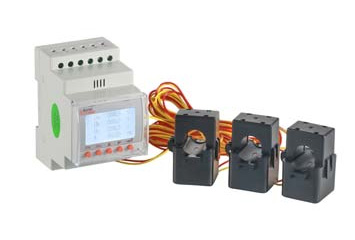
For solar developers and EPC contractors, the meter is not an afterthought. It is a critical system component that must integrate seamlessly with the inverter, comply with local utility interconnection requirements, and provide data for performance monitoring and financial reporting. The DTSD1352-C solar inverter smart meter exemplifies the current generation of meters designed specifically for this application — offering Class 0.5S accuracy, bidirectional measurement, RS485 Modbus-RTU communication, and inverter compatibility in a compact DIN rail housing.
EV Charging Infrastructure
The expansion of EV charging networks requires accurate energy measurement for billing, load management, and grid interaction. Three-phase DIN rail meters are the preferred solution for AC charging stations and sub-meters within DC fast-charging cabinets.
Industrial Energy Management
Manufacturing facilities are deploying sub-metering systems to track energy consumption by process line, department, or individual machine — supporting cost allocation, efficiency programs, and ISO 50001 compliance.
Commercial Building Automation
Building management systems rely on energy meter data for HVAC optimization, tenant billing, and green building certification (LEED, BREEAM).
Utility Smart Grid Deployments
Utilities are modernizing metering infrastructure to support demand response, grid stability management, and time-of-use tariff structures.
Procurement Considerations for Distributors and EPCs
Selecting a three-phase DIN rail meter requires evaluating factors beyond the datasheet — factors that affect long-term reliability, compliance, and total cost of ownership.
Certification Requirements
Regulatory compliance is non-negotiable, and the requirements vary by market:
| Certification | Scope | Markets |
|---|
| MID (MI-003) | Active energy measurement accuracy | European Union |
| CE | Electrical safety, EMC | European Economic Area |
| IEC 62053-22/23 | Meter accuracy and testing standards | International |
| EAC | Eurasian Customs Union safety and quality | Russia, Belarus, Kazakhstan, Armenia, Kyrgyzstan |
| UL/cUL | Electrical safety | North America |
Sourcing meters with multiple certifications simplifies inventory management and reduces compliance risk across regions.
Inverter Compatibility
For solar applications, the meter must communicate with the inverter's monitoring platform — typically via RS485 Modbus-RTU — to provide real-time data for self-consumption optimization and performance monitoring. Verify compatibility with the inverter brands most commonly deployed in your target market before committing to a model.
Total Cost of Ownership vs. Unit Price
A meter's purchase price represents only a fraction of its total cost. Factors that influence TCO include:
Installation labor: Compact DIN rail form factors reduce installation time
Commissioning complexity: Meters with auto-detection and intuitive configuration tools lower setup costs
Communication infrastructure: Protocol compatibility with existing systems avoids costly adapters or gateway devices
Reliability and failure rates: Lower failure rates reduce warranty claims and field service costs
Data integration: Meters that output standard data formats reduce software integration effort
Supply Chain Reliability
Evaluate potential suppliers on manufacturing capacity, component sourcing resilience, and ability to deliver consistent lead times during demand surges. Vertically integrated manufacturers with established logistics networks offer a significant advantage.
After-Sales Support and Warranty
Energy meters typically operate for 10 to 15 years in the field. The quality of after-sales support, availability of configuration tools, and warranty terms all affect the distributor's reputation and end customer satisfaction.
Competitive Landscape Overview
The three-phase DIN rail energy meter market includes established multinationals, regional specialists, and emerging technology providers. Competition is intensifying, with differentiation centered on:
Communication versatility: The ability to support multiple protocols and integrate with diverse monitoring platforms
Accuracy at accessible price points: Class 0.5S performance without premium pricing
Feature modularity: Options for harmonic analysis, multi-tariff registration, and temperature monitoring that can be specified based on application requirements
Form factor and installation simplicity: Compact designs that fit standard DIN rail enclosures and require minimal commissioning
Certification breadth: Products that carry multiple international certifications, simplifying cross-border distribution
The market is consolidating around suppliers that can deliver across all of these dimensions simultaneously, rather than excelling in a single area.
Evaluating a DIN Rail Meter Supplier: A Practical Checklist
For distributors and EPC contractors evaluating potential meter suppliers, the following criteria provide a structured framework:
| Criterion | What to Assess |
|---|
| Product range | Does the supplier offer models covering your target applications and voltage/current ranges? |
| Accuracy class | Are Class 0.5S and Class 1 options available for appropriate segmentation? |
| Communication protocols | Is RS485 Modbus-RTU standard? Are Ethernet, LoRaWAN, or cellular options available? |
| Bidirectional capability | Can the meter measure both import and export energy for solar and storage applications? |
| Certifications | Does the product carry MID, CE, IEC, EAC, or other certifications required in your markets? |
| Form factor | Is the meter DIN rail mountable? What are the physical dimensions? |
| Optional features | Are harmonic analysis, multi-tariff, and temperature monitoring available as configurable options? |
| Inverter compatibility | Has the meter been tested and verified with major inverter brands? |
| Manufacturing capacity | Can the supplier scale production to meet growing demand? |
| Lead times | What are standard delivery times? How are surge orders handled? |
| Warranty terms | What is the warranty period? What does it cover? |
| Technical support | Is configuration software provided? Is technical support responsive and knowledgeable? |
| References | Can the supplier provide references from comparable installations? |
Current-Generation Technology in Practice: DTSD1352
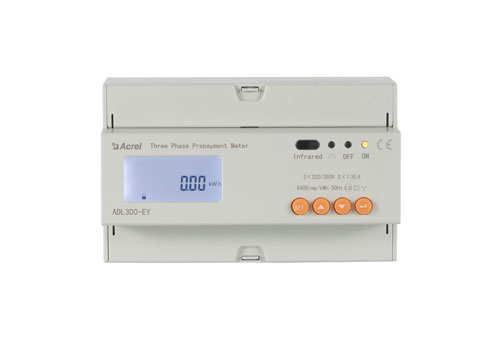
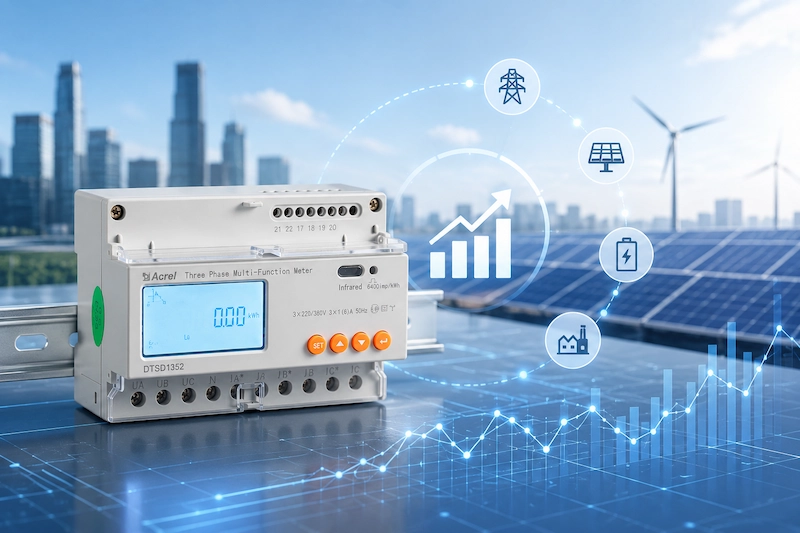
To ground these trends in a concrete product example, consider the DTSD1352-C three-phase DIN rail energy meter — a representative current-generation device that illustrates how the technology trends discussed above are being implemented in shipping products.
The DTSD1352-C operates at 230/400V across three phases and delivers Class 0.5S active energy accuracy with Class 2 reactive accuracy. It communicates via RS485 Modbus-RTU, providing native compatibility with the majority of industrial monitoring systems, building management platforms, and solar inverter brands.
Key specifications include:
Bidirectional measurement: Registers both imported and exported energy, making it suitable for solar PV and energy storage applications
DIN rail mounting: Standard 35mm rail, with compact dimensions of 126×91×74mm and a weight of just 0.35kg
LCD display: On-site readability without auxiliary tools
Modular options: Harmonic analysis (/H), multi-tariff registration (/F), and temperature monitoring (/T) available as configurable options
Certifications: CE, EAC, and IEC compliant, supporting deployment across European and Eurasian markets
The DTSD1352-C is particularly relevant for solar inverter monitoring applications, where its bidirectional capability, Modbus-RTU communication, and compact DIN rail form factor align directly with the requirements of modern PV system design.
FAQ
What is driving the growth of the three-phase DIN rail energy meter market in 2026?
The primary drivers are solar PV expansion (creating demand for bidirectional metering), industrial IoT adoption (embedding meters into operational technology systems), government-mandated smart grid modernization programs, and tightening energy efficiency regulations that require granular energy monitoring in commercial and industrial facilities.
Why is bidirectional metering important for solar installations?
Solar installations export surplus energy to the grid and import energy when generation is insufficient. A bidirectional meter accurately measures both flows, which is essential for net metering calculations, feed-in tariff billing, self-consumption optimization, and compliance with utility interconnection agreements.
What accuracy class should I specify for commercial energy metering?
Class 0.5S is the recommended standard for commercial and industrial applications, providing ±0.5% accuracy across a wide range at price points previously associated with Class 1 meters. For revenue billing and performance guarantee verification, Class 0.5S delivers the precision that Class 1 cannot match.
Which communication protocol should I choose for DIN rail meter integration?
RS485 Modbus-RTU remains the most practical choice for most installations. It is reliable, well-understood, and supported by virtually every building management system, SCADA platform, and solar inverter on the market. For installations where wired communication is impractical — such as distributed solar farms or remote utility assets — LoRaWAN or cellular (NB-IoT/4G) options provide wireless connectivity.
How do I verify that a DIN rail meter is compatible with my inverter system?
Check the meter's communication protocol (RS485 Modbus-RTU is the standard for inverter integration), confirm the register map is documented and accessible, and verify that the inverter manufacturer's monitoring platform lists the meter model as a supported device. Leading meter manufacturers publish inverter compatibility lists and provide configuration guides for common integration scenarios.
 English