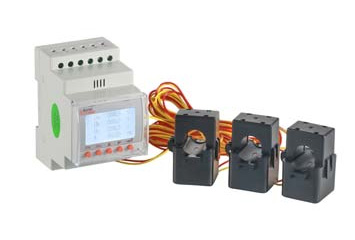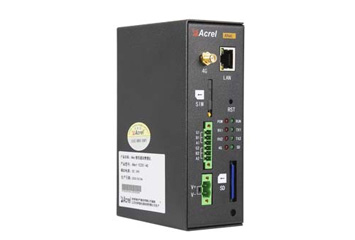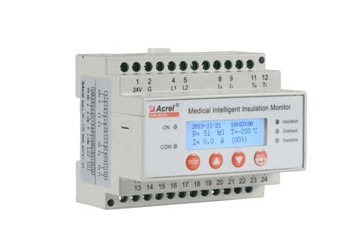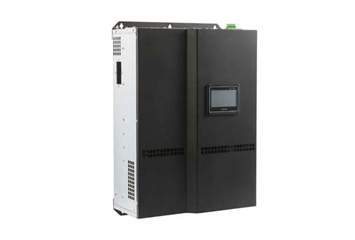
When planning a photovoltaic installation, most of the attention goes to panel selection, inverter sizing, and mounting structure. The energy meter — the device that sits between your PV system and the electrical panel — is often treated as an afterthought. That is a costly mistake. The energy meter for your solar inverter determines how accurately you monitor generation, how effectively you manage self-consumption, and whether your system can participate in feed-in tariff programs or demand-response schemes.
Selecting the wrong meter can lead to inaccurate billing, inverter communication failures, non-compliance with utility requirements, and missed revenue from exported energy. This guide walks through every specification that matters, compares the available options, and helps you identify the right meter for commercial and industrial PV projects.
Why the Energy Meter Matters in a PV System
The inverter converts DC to AC. The meter measures what happens next — how much energy your system generates, how much your facility consumes, and how much flows back to the grid. Without accurate metering, you cannot:
Optimize self-consumption: Real-time energy data allows the inverter or energy management system to adjust output, curtail export, or trigger battery charging.
Comply with feed-in tariff requirements: Many utilities and regulatory bodies require bidirectional meters with a certified accuracy class for net metering or feed-in billing.
Diagnose performance issues: A discrepancy between inverter-reported generation and metered output can reveal wiring losses, inverter derating, or shading problems that would otherwise go unnoticed.
Enable smart energy management: Advanced meters with Modbus communication feed data into SCADA systems, building management platforms, and cloud dashboards for remote monitoring.
In short, the meter is the instrumentation layer of your PV system. Without it, you are flying blind.
Key Selection Criteria: A Comprehensive Comparison
Direct-Connected vs. CT-Connected Meters
The first decision is how the meter connects to the electrical circuit.
| Parameter | Direct-Connected | CT-Connected |
|---|
| Current range | Up to 80–100A typical | Up to thousands of amps via CT ratio |
| Installation complexity | Simpler — no external CTs | Requires CT installation and wiring |
| Accuracy | Generally higher at low loads | Depends on CT accuracy class |
| Best for | Residential, small commercial | Large commercial, industrial, switchgear |
| Cost | Lower overall | Higher (meter + CTs) |
| Service interruption | May require breaker disconnect | CTs can often be installed on existing conductors |
For most commercial PV installations under 80A per phase, a direct-connected meter offers a cleaner installation and avoids the additional uncertainty introduced by external current transformers.
Single-Phase vs. Three-Phase
Residential systems in many regions operate on a single phase, but commercial and industrial installations almost always use three-phase power. A three-phase energy meter for solar applications should measure all three phases independently to detect imbalance, which can affect inverter performance and trigger utility penalties.
Even if your PV system is single-phase, a three-phase meter may be required at the point of common coupling (PCC) to measure total site consumption and export accurately.
Accuracy Class: What It Means for Your Bottom Line
Energy meter accuracy is expressed as a percentage deviation from true value under reference conditions. The relevant IEC standards (IEC 62053-22 for active energy, IEC 62053-23 for reactive energy) define several classes:
| Accuracy Class | Active Energy Deviation | Typical Application | Financial Impact |
|---|
| 0.2S | ±0.2% | Revenue billing, large generators | Highest precision; required for utility-scale billing |
| 0.5S | ±0.5% | Commercial PV, feed-in tariff metering | Recommended for projects where exported energy is billed or compensated |
| 1.0 | ±1.0% | General industrial monitoring | Acceptable for self-consumption monitoring where billing is not critical |
| 2.0 | ±2.0% | Basic monitoring | Not recommended for PV systems with feed-in compensation |
To put this in perspective: a 500 kW PV system generating 600,000 kWh annually, with a feed-in tariff of €0.08/kWh, produces €48,000 in export revenue. The difference between a Class 2 meter (±2%) and a Class 0.5S meter (±0.5%) is up to €720 per year in measurement uncertainty — every year, for the 10–15 year life of the system. The cost premium for a higher-accuracy meter is typically recovered within the first year.
Communication Protocols and Inverter Compatibility
The communication interface is what makes a meter "smart" and allows it to integrate with inverters, energy management systems, and monitoring platforms. The most common protocols include:
RS485 Modbus-RTU: The de facto standard for industrial energy metering. Nearly every major inverter brand supports Modbus-RTU over RS485 for external meter connectivity. This is the protocol you should prioritize for maximum compatibility.
DL/T645: A Chinese protocol standard. If your project is in Europe, Southeast Asia, or the Americas, this is generally not relevant.
Pulse output: A simple dry-contact or solid-state pulse proportional to energy consumed. Limited to basic monitoring; no real-time power data.
Wi-Fi / Ethernet / Cellular: Found in some residential smart meters. Useful for cloud monitoring but not always supported by commercial inverters for direct control functions.
For commercial PV systems, RS485 Modbus-RTU is the clear recommendation. It provides real-time voltage, current, power, power factor, and energy data with minimal latency and is supported by virtually every inverter manufacturer.
Bidirectional Measurement
A solar inverter smart meter must measure energy in both directions — energy consumed from the grid and energy exported back to it. Not all meters support bidirectional measurement. If your meter only records forward energy (import), any energy you export will either be ignored or, worse, added to your consumption reading.
Look for meters that explicitly state bidirectional or import/export measurement capability. This is non-negotiable for any PV system with net metering or feed-in tariff arrangements.
Form Factor: DIN Rail vs. Panel Mount
| Form Factor | Advantages | Considerations |
|---|
| DIN rail (35mm) | Standardized mounting, easy integration into distribution boards, compact | Requires DIN rail space in the panel |
| Panel mount | Larger display, suitable for standalone installations | Requires panel cutout, more space |
For most PV installations where the meter goes inside a distribution board or sub-panel, DIN rail mounting is the practical choice. It keeps the installation clean and consistent with other protective devices.
Certifications
Certifications are not optional — they are prerequisites for project approval and utility acceptance. Key standards to look for:
CE marking: Mandatory for equipment sold in the European Economic Area.
MID (Measuring Instruments Directive): Required in EU member states for meters used in billing or custody transfer. MID-certified meters carry a "MID" module marking.
IEC 62053-22/23: Defines accuracy class testing procedures for active and reactive energy measurement.
IEC 62052-11: General requirements for electromechanical and electronic meters.
If your PV system feeds energy back to the grid and you expect to be compensated, verify that your chosen meter carries the certifications required by your local utility and regulatory body.
Inverter Compatibility: What You Need to Know
Major inverter manufacturers each have specific requirements and tested meter compatibility lists. Here is a summary of the leading brands and their communication requirements:
| Inverter Brand | Preferred Protocol | Meter Interface | Notes |
|---|
| Sungrow | RS485 Modbus-RTU | Dedicated meter port | Supports external meter for self-consumption management; well-documented Modbus register map |
| SolarEdge | RS485 Modbus-RTU | Via RS485 bus | Meter connects to inverter's RS485 port; specific registers for import/export power |
| Huawei | RS485 Modbus-RTU | Smart MBUS or RS485 | FusionSolar platform reads meter data directly; MBUS is Huawei-proprietary but RS485 is standard |
| Solis | RS485 Modbus-RTU | Dedicated meter port | Supports multiple external meters; commonly paired with third-party DIN rail meters |
| Goodwe | RS485 Modbus-RTU | BMS or meter port | Supports external meter for zero-export control and self-consumption optimization |
The common thread: all major brands support RS485 Modbus-RTU. If your meter speaks Modbus-RTU over RS485, it will work with virtually any commercial inverter on the market. The key is verifying the register map — the specific data addresses the inverter expects to read from the meter. Most meter manufacturers provide register documentation, and many inverter manufacturers publish tested compatibility lists.
Before purchasing, confirm that the meter's Modbus register map includes the data points your inverter requires: typically, total active power, total imported energy, and total exported energy.
Installation Considerations
Wiring and Connection
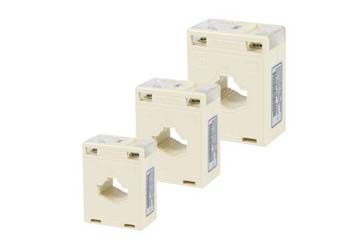
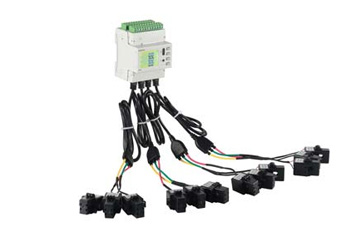
For a direct-connected three-phase meter, you will connect four wires (L1, L2, L3, N) for voltage sensing, and the current paths are integrated into the meter body. For CT-connected meters, the voltage wiring is the same, but current is sensed through external CTs that clamp around the conductors.
Key installation points:
Install the meter as close to the point of common coupling as possible to minimize measurement error from cable losses.
Ensure correct phase sequence (L1-L2-L3) — incorrect phase rotation will produce inaccurate readings.
For CT-connected meters, verify CT orientation (the arrow or "P1/P2" marking on the CT must point toward the load).
Use shielded twisted-pair cable for RS485 communication to avoid electromagnetic interference, especially in environments with high-power conductors nearby.
CT Placement (for CT-Connected Meters)
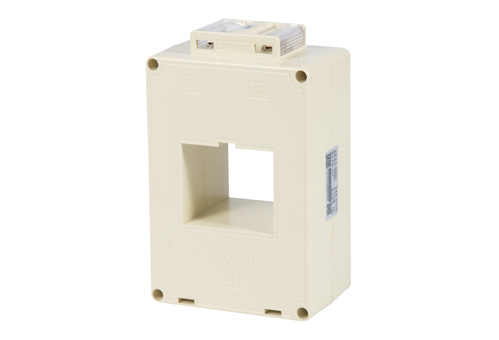
Place CTs on the supply-side conductors at the PCC. The CTs should be sized appropriately — a CT rated for 100A/5A used on a circuit that only draws 20A will have poor accuracy at the low end. Match CT capacity to expected load as closely as possible.
Communication Setup
RS485 networks use a daisy-chain topology. Terminate both ends of the bus with 120-ohm resistors to prevent signal reflection. Set the meter's Modbus address to a unique value on the bus (typically 1–247), and configure the baud rate and parity to match the inverter's requirements (common settings: 9600 baud, 8N1 or 9600 baud, 8E1).
Common Mistakes in Meter Selection for Solar Projects
Choosing a meter without bidirectional capability. This is the single most frequent error. If the meter cannot measure export energy, the PV system's contribution to grid feed-in is invisible, and billing or compensation becomes impossible.
Ignoring accuracy class. Specifying a Class 2 meter for a system that feeds into a tariff program is a false economy. The measurement uncertainty compounds over the system's lifetime.
Mismatched communication protocols. Selecting a meter with only pulse output when the inverter requires Modbus-RTU for real-time power control (such as zero-export or power-limiting functions) renders the smart features useless.
Incorrect CT sizing. Oversized CTs on low-current circuits produce poor accuracy at typical operating loads. Always match CT range to expected circuit current.
Neglecting certification requirements. Installing a non-certified meter in a jurisdiction that requires MID or utility-approved metering will result in rejected inspections and project delays.
Poor placement. Installing the meter on the wrong side of the distribution board — after a non-monitored branch circuit — means some loads are invisible to the monitoring system, making self-consumption calculations unreliable.
Cost Considerations and ROI of Proper Metering
A commercial-grade three-phase energy meter with RS485 Modbus-RTU, Class 0.5S accuracy, and bidirectional measurement typically costs between €40 and €120, depending on features and certifications. CT-connected variants may cost slightly less for the meter itself but additional CTs add €15–50 per phase.
Against this cost, consider the value:
A 100 kW system exporting 40% of generation at a feed-in rate of €0.08/kWh generates roughly €3,200/year in export revenue. Accurate metering at ±0.5% vs ±2% protects €48/year in measurement margin.
Self-consumption optimization, enabled by real-time meter data, can shift an additional 5–15% of generation from export to self-use, which at a retail rate of €0.15/kWh is worth €600–1,800/year on a 100 kW system.
Remote monitoring and fault detection reduce O&M response time, preventing extended periods of undetected underperformance.
The meter pays for itself within the first few months of operation.
Recommendation: A Proven Solution for Commercial PV Metering
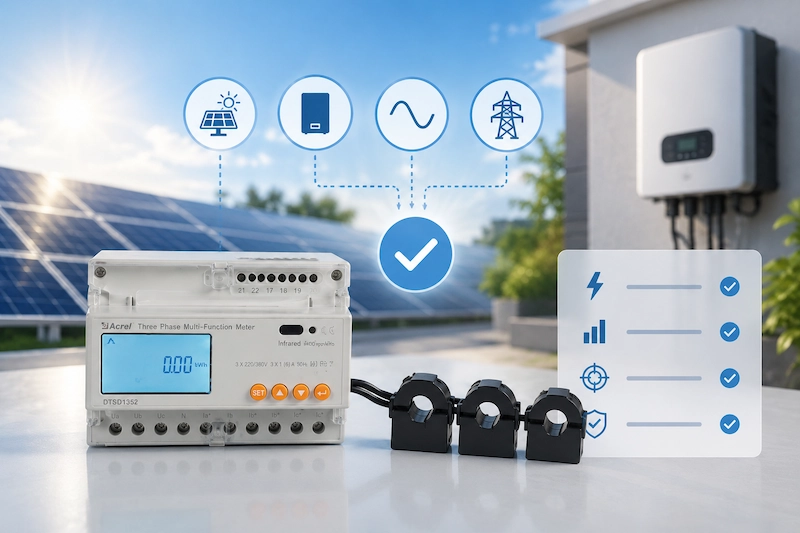
After evaluating the selection criteria above, one meter that consistently meets the requirements of commercial PV installations is the DTSD1352-C solar inverter smart meter.
Here is how its specifications align with the criteria discussed:
| Specification | DTSD1352-C | Why It Matters |
|---|
| Accuracy class | Class 0.5S active / Class 2 reactive | Meets the threshold for feed-in tariff metering and commercial energy monitoring |
| Phases | Three-phase, 230/400V | Covers the majority of commercial and industrial PV installations |
| Current range | 3×10(80)A direct connect; 3×1(6)A CT option | Flexible for small to medium commercial loads without external CTs |
| Communication | RS485 Modbus-RTU | Compatible with Sungrow, Solis, SolarEdge, Huawei, Goodwe and other major inverter brands |
| Measurement | Bidirectional (import/export) | Essential for net metering and feed-in tariff compliance |
| Form factor | DIN rail 35mm, 126×91×74mm, 0.35kg | Compact, fits standard distribution boards |
| Display | LCD | On-site readability for commissioning and maintenance |
| Certifications | CE, EAC, IEC compliant | Meets European and international regulatory requirements |
| Optional features | Harmonic analysis (/H), multi-tariff (/F), temperature monitoring (/T) | Scalable for advanced applications like power quality analysis |
The DTSD1352-C addresses the most common pain points in solar meter selection: it provides bidirectional measurement with Class 0.5S accuracy, communicates via the universally supported RS485 Modbus-RTU protocol, and mounts on a standard DIN rail in a compact form factor. Its tested compatibility with major inverter brands reduces commissioning risk and eliminates protocol mismatch issues.
For projects requiring harmonic analysis — increasingly relevant as grid codes tighten around power quality for PV connections — the /H variant provides harmonic spectrum data up to the 31st order. The multi-tariff /F option supports time-of-use billing structures common in European markets.
FAQ
Can I use the same energy meter for both solar monitoring and utility billing?
It depends on local regulations. In many European markets, the utility installs and certifies its own meter at the grid connection point for billing purposes. Your solar monitoring meter sits on the inverter side of the main breaker and provides data for self-consumption optimization, inverter control, and performance monitoring. In some net-metering arrangements, a single certified bidirectional meter can serve both functions. Check with your local utility and regulatory authority.
What happens if my meter is less accurate than my inverter's reported generation?
You will see a discrepancy between the inverter's generation log and the meter's recorded output. This difference represents system losses (cable resistance, transformer losses, measurement uncertainty) plus any meter inaccuracy. If the discrepancy exceeds what wiring losses can explain, the meter accuracy is likely the cause. For billing applications, the meter reading is typically the authoritative value, which is why investing in a higher accuracy class protects your revenue.
Do I need a different meter for single-phase and three-phase systems?
Yes. A single-phase meter cannot measure three-phase systems correctly. However, a three-phase meter can be used on single-phase systems by connecting only one voltage and one current channel — though this is an inefficient use of the meter's capability. For mixed installations, specify the meter based on the connection type at the point where measurement is required.
How do I verify that my meter is compatible with my specific inverter model?
Check the inverter manufacturer's documentation for supported external meter models and communication requirements. Most manufacturers publish a tested compatibility list. If your chosen meter is not on the list, verify that it supports RS485 Modbus-RTU and request the meter's Modbus register map from the manufacturer. If the register map includes the data points the inverter requires (active power, imported energy, exported energy), integration is typically straightforward.
Is DIN rail mounting secure enough for industrial environments?
Yes. DIN rail mounting is the international standard for industrial electrical equipment. It is used for circuit breakers, contactors, PLCs, and energy meters in installations worldwide. The 35mm DIN rail provides a secure, standardized mounting method that withstands vibration and is accepted by all major electrical inspection authorities. Ensure the distribution board has adequate rail space and that the meter is properly snapped onto the rail during installation.
 English